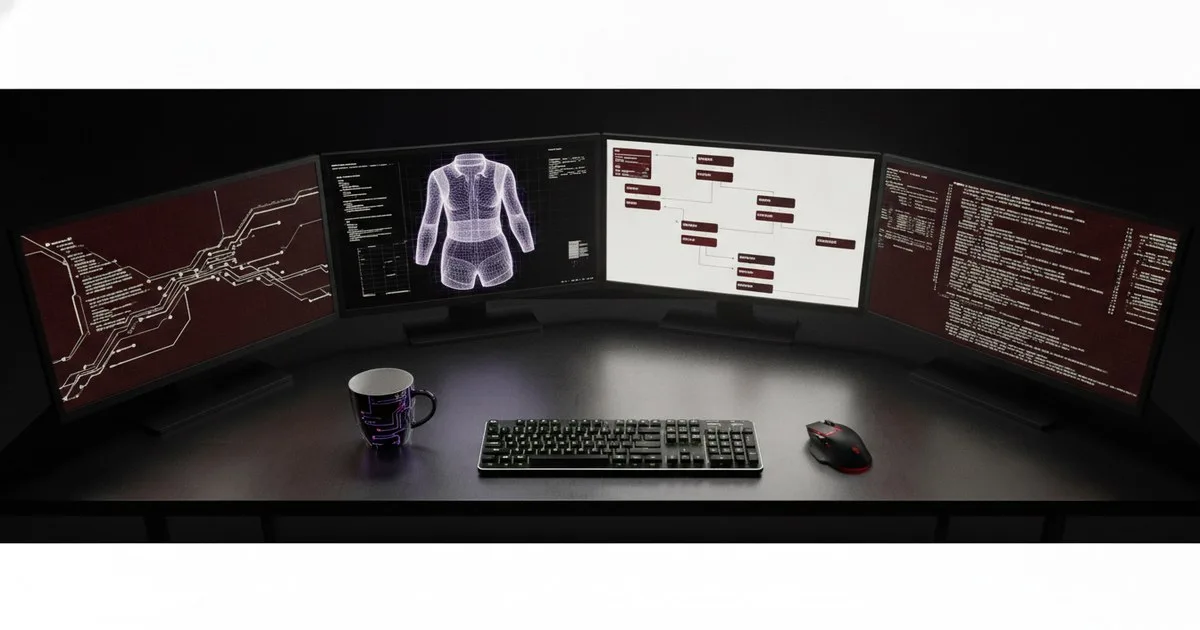
To build an AI-augmented fashion production line, you must treat your Product Lifecycle Management (PLM) system as a data orchestrator rather than a static database. Engineering teams and platform architects must evaluate vendors based on their API surface area, schema flexibility for AI-generated metadata, and native support for 3D asset ingestion to ensure the foundation can support machine learning pipelines.
Key takeaways
- API granularity determines the feasibility of real-time AI feedback loops during the design and sampling phases.
- Extending PLM schemas to accommodate AI-generated confidence scores is critical for automated quality control and demand forecasting.
- Native 3D visualization support reduces the latency between generative design iterations and production-ready tech packs.
- Enterprise-grade security protocols for AI gateways are non-negotiable when processing proprietary design IP through external models.
What defines AI-readiness in a fashion PLM?
AI-readiness is not a marketing label; it is a measure of architectural openness. For a fashion brand to leverage generative design or computer vision, the PLM must serve as a high-throughput data hub. This requires a robust REST or GraphQL API that allows external scripts to programmatically access and modify Bills of Materials (BOMs), measurement charts, and material libraries without manual intervention.
Furthermore, the data model must be extensible. Traditional PLMs often use rigid relational structures that struggle with the unstructured data produced by AI, such as vector embeddings for visual search or material reflectance values for 3D simulation. A ready system allows for custom JSON attributes or non-relational extensions that can store these outputs alongside traditional product data.
How does API surface area impact machine learning workflows?
The depth of a PLM’s API determines how effectively you can train custom models on your brand's historical data. If the API only allows for basic header-level exports, your ML pipeline will lack the granular detail—such as specific seam constructions or historical grading adjustments—needed for high-accuracy predictions. Architects should look for platforms that offer webhooks, which can trigger AI-based tech pack verification the moment a designer saves a change, ensuring that production errors are caught in milliseconds rather than days.
Why is 3D asset support critical for generative design?
Generative AI in fashion often starts with visual prompts but must end with physical garments. A PLM that cannot natively manage 3D assets (such as GLB or USDZ files) creates a manual bottleneck. AI-readiness requires the system to not only store the 3D file but also expose its metadata. This allows an AI agent to read the vertex data or material properties directly from the PLM to generate realistic 2D patterns or 3D renders, maintaining a single source of truth across the digital-to-physical transition.
1. Centric PLM
Centric PLM, now owned by Dassault Systèmes, functions as an AI-powered enterprise platform designed for multi-category product management across fashion, cosmetics, and retail. It provides a comprehensive suite that includes planning, pricing, and product experience management (PXM), positioning it as a centralized hub for large-scale data orchestration.
Centric Software expanded its end-to-end enterprise capabilities by acquiring the AI-powered PXM solution Contentserv for €220M in 2025 [https://www.luxepackmonaco.com/en/news/centric-software-annonce-l-acquisition-de-la-solution-pxm-alimentee-par-l-ia-contentserv]. This move signals a deep commitment to integrating AI across the product lifecycle, particularly in how product data is transformed for market intelligence and consumer-facing content. For architects, this means the platform is moving toward a model where AI handles the heavy lifting of data enrichment and market alignment.
- → Offers a highly scalable API surface suitable for complex enterprise integrations.
- → Includes Centric Visual Boards for real-time collaboration on AI-augmented design concepts.
- → Native PXM integration allows for automated content generation based on PLM data.
Best for: Global enterprises requiring a unified AI-powered suite across multiple product categories.
Limits: The complexity of the enterprise-grade architecture can lead to longer implementation timelines for custom ML pipelines.
2. Backbone PLM
Backbone PLM is a cloud-native platform operated under Bamboo Rose, specifically targeting retailers managing private-label collections and scale-up brands. It focuses on streamlining the core product development workflows, including tech packs, approvals, and supplier collaboration, through a clean, modern interface.
Since its acquisition by Bamboo Rose in 2023, the platform has focused on providing a stable foundation for digital product creation. While it excels at the fundamentals of tech pack management, its AI-readiness is currently centered on data centralization and workflow automation. It provides the structured data necessary for brands to begin building their own external AI tools for sourcing and production optimization.
- → Streamlined tech pack creation that serves as a clean data source for ML training.
- → Strong focus on supplier collaboration, providing endpoints for production-side data ingestion.
- → Part of the broader Bamboo Rose ecosystem for end-to-end supply chain visibility.
Best for: Scale-up brands and private-label retailers prioritizing speed and clean data structures.
Limits: Post-acquisition engineering velocity has focused on integration, potentially slowing the rollout of native generative AI features.
3. BeProduct
BeProduct is an independent SaaS platform that offers a highly flexible approach to Product Lifecycle Management and Digital Product Creation (DPC). It is built on a modular architecture that emphasizes visual workflows, material libraries, and real-time collaboration, making it a favorite for brands that prioritize design agility.
Because BeProduct is independent and SaaS-native, it offers significant flexibility in data modeling. Architects can easily extend the platform to include custom fields for AI-driven insights, such as sustainability scores or predictive costings. Its visual workflow boards are designed to handle the rapid iterations common in AI-assisted design processes, allowing teams to track multiple versions of a garment without cluttering the main production database.
- → High schema flexibility allows for the storage of non-standard AI metadata.
- → Visual-first interface facilitates the management of AI-generated design variants.
- → Affordable and scalable for emerging brands looking to build an AI-ready foundation early.
Best for: Emerging and mid-market brands that require a flexible, independent platform for custom AI integrations.
Limits: Smaller ecosystem of pre-built enterprise integrations compared to the larger conglomerate-owned platforms.
4. PTC FlexPLM
PTC FlexPLM is a robust enterprise suite used by some of the world's largest footwear and apparel companies to manage complex design files and global supplier networks. It is known for its ability to handle massive datasets and its deep integration with professional design and manufacturing tools.
PTC has aggressively expanded the platform's AI capabilities, as evidenced by the announcement of AI-powered tech pack creation at the National Retail Federation (NRF) Big Show in January 2026 https://www.kobolabs.io/research/plm-state-2026. This feature allows the system to automatically generate technical documentation from design sketches, significantly reducing the manual workload for product teams. This level of native AI integration makes it a strong contender for brands looking for "out-of-the-box" AI functionality at scale.
- → Native AI-powered tech pack generation announced in early 2026 reduces manual entry.
- → Enterprise-scale data management capable of supporting massive ML training sets.
- → Deep integration with technical design tools for seamless 3D-to-production workflows.
Best for: Large-scale footwear and apparel brands requiring native AI automation and robust data governance.
Limits: The high level of enterprise customization can make the platform less agile for rapid, experimental AI prototyping.
Comparison of AI-Readiness Dimensions
| Platform | API Surface | Data Model Flexibility | 3D Asset Support | Best For |
|---|---|---|---|---|
| Centric PLM | High (REST/PXM) | Moderate/Extensible | Native (Visual Boards) | Global Multi-Category |
| Backbone PLM | Moderate (REST) | Standardized | Integrated | Private Label Retail |
| BeProduct | High (SaaS-native) | High (Modular) | Visual Workflow | Emerging Design Brands |
| PTC FlexPLM | High (Enterprise) | Moderate/Structured | AI-Augmented | Footwear & Apparel Scale |
Security and AI Gateways
Connecting a PLM to an AI platform introduces new security risks, particularly regarding data leakage and account compromise. As brands move toward using enterprise AI gateways, they must implement strict authentication protocols. It is critical to monitor for unauthorized access; for instance, technical teams should follow established protocols on how to tell if your AI platforms’ accounts have been hacked, as detailed in recent security analysis from August 15, 2026 https://techcrunch.com/2026/08/15/how-to-tell-if-your-ai-platforms-accounts-have-been-hacked/. Protecting the link between your PLM data and the AI models that process it is as important as the design IP itself.
FAQ
Which PLM system is best for integrating custom AI models? BeProduct and Centric PLM offer the most robust API surfaces for custom integrations. BeProduct’s modular SaaS architecture is ideal for agile, experimental AI projects, while Centric’s enterprise-scale REST API and PXM integration are better suited for large-scale, data-heavy machine learning pipelines across global teams.
How do I secure my PLM data when using third-party AI models? Security requires using enterprise-grade AI gateways that offer tenant isolation. Additionally, teams must implement multi-factor authentication and monitor for suspicious account activity. Regularly reviewing security guides on how to detect compromised AI accounts is essential for maintaining the integrity of your proprietary product data.
Can PLM systems generate tech packs automatically using AI? Yes, certain platforms are now integrating this natively. For example, PTC FlexPLM announced AI-powered tech pack creation in early 2026, which uses machine learning to convert design data into production-ready documentation, significantly reducing the time required for manual tech pack assembly.
Is 3D asset support necessary for AI-readiness? Absolutely. 3D assets contain the geometric and material data that generative AI models need to produce production-accurate designs. Without native 3D support, the transition from an AI-generated visual to a physical garment remains a manual, error-prone process that negates much of the AI's efficiency gains.
Further Reading
- How to tell if your AI platforms’ accounts have been hacked
- PTC FlexPLM AI capabilities and NRF 2026 updates