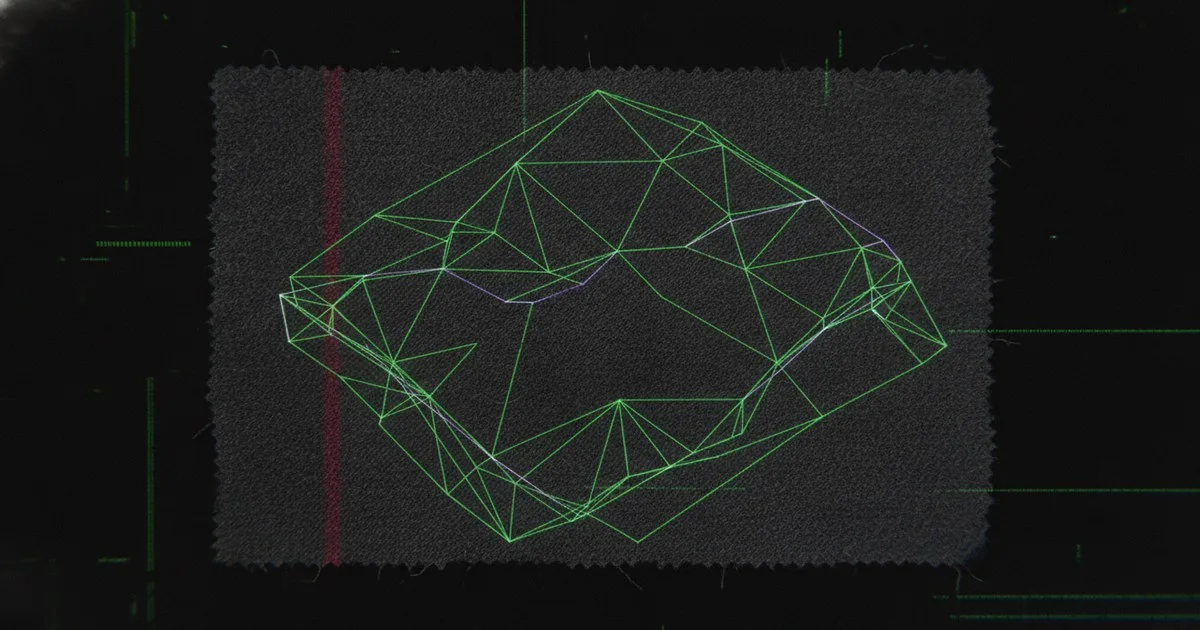
Engineering for the fashion industry requires bridging the gap between soft-goods intuition and hard-code precision. When building simulation engines, generative design pipelines, or supply chain integrations, vague descriptors like "fit" or "feel" lead to system failures and misaligned vendor deliveries. This guide defines ten core technical terms with the precision required for engineering specifications and vendor RFPs.
Key takeaways
- Drape must be defined by physical parameters like bending and shear modulus to be simulated accurately.
- BRDF is the non-negotiable standard for realistic material light transport in digital environments.
- Finite Element Analysis (FEA) solvers determine the accuracy of garment-on-body collision detection.
- Product Lifecycle Management (PLM) serves as the relational database backbone for all technical metadata.
How do I specify fabric behavior in a simulation engine?
To simulate how a garment behaves, you must move beyond visual approximations and define the physical properties of the textile. This involves mapping the nonlinear deformation of fabrics into a mathematical model that a solver can process. Systems like Seddi focus on creating true-to-pattern digital replicas by capturing these mechanical properties at the fiber and weave level.
What is the difference between a garment mesh and a pattern?
A pattern is a 2D geometric representation of a garment piece, usually stored in DXF or PDF format, while a garment mesh is the 3D discretization of that pattern into vertices, edges, and faces. The transformation from 2D to 3D requires a stable grainline definition and a robust FEA solver to handle the stress and strain of the assembly process.
1. Drape
Drape is the deformation of a fabric under its own weight, governed by bending stiffness, shear modulus, and mass density. In engineering terms, it is the steady-state solution of a non-linear elastic system where gravity is the primary external force. High-fidelity drape simulation requires measuring the fabric's resistance to multi-axial deformation.
- → Bending stiffness (mg*cm)
- → Shear resistance (N/m)
- → Drape coefficient (percentage of shadow area)
In design workflows, drape is the primary indicator of how a 2D pattern will translate into a 3D silhouette. Tools like Seddi utilize these mechanical parameters to ensure that a digital garment behaves identically to its physical counterpart during movement.
Best for: Predicting silhouette and volume in 3D digital product creation. Limits: Computationally expensive for real-time applications without pre-computation or simplified physics.
2. Grainline
The grainline defines the orientation of the warp (longitudinal) threads in a woven fabric. In a 3D simulation environment, the grainline establishes the primary axis for the material's stiffness matrix, as textiles are inherently anisotropic—they exhibit different mechanical properties along different axes.
- → Warp/Weft orientation (theta)
- → Anisotropic stiffness mapping
- → Bias-cut deformation (45-degree shift)
For engineers, the grainline is the reference vector for all stress-strain calculations. Browzwear uses this data within its VStitcher platform to ensure that the 3D garment stretches and hangs correctly relative to the fabric's internal structure.
Best for: Ensuring structural integrity and fit accuracy in 2D-to-3D conversion. Limits: Often ignored or simplified in low-fidelity generative AI outputs, leading to unrealistic garment behavior.
3. Seam Allowance
Seam allowance is the specified offset between the edge of a pattern piece and the actual stitching line. While designers view it as a safety margin for construction, engineers must treat it as a critical parameter for DXF/ASTM export and 3D assembly logic.
- → Offset distance (mm or inches)
- → Corner treatment (mitred, blunt, or notched)
- → Grade rules for variable sizing
In a technical workflow, the seam allowance must be precisely subtracted during the 3D sewing process to avoid artificial bulk at the joints. Failure to define this leads to incorrect garment circumference and fit errors in the virtual prototype.
Best for: Production-ready pattern drafting and automated marker making. Limits: Adds complexity to the mesh topology at the seams, increasing the risk of collision artifacts.
4. BRDF (Bidirectional Reflectance Distribution Function)
Bidirectional Reflectance Distribution Function (BRDF) is a four-dimensional function that defines how light is reflected at an opaque surface. For fashion-tech, this replaces simple "texture maps" with a mathematical description of how a fabric interacts with light from any given direction.
- → Specular and diffuse reflectance components
- → Surface roughness and anisotropy maps
- → Subsurface scattering for sheer or translucent materials
Material scanners from Vizoo capture these optical properties using xTex technology, allowing engineers to maintain visual parity across different render engines. This ensures that a silk satin looks like silk satin regardless of the lighting environment.
Best for: Achieving photorealistic renders for e-commerce and high-end marketing assets. Limits: Requires specialized hardware for accurate data acquisition and high VRAM for rendering.
5. Latent Diffusion
Latent diffusion is a generative AI architecture that performs the denoising process in a lower-dimensional latent space rather than the high-dimensional pixel space. In fashion-tech, this is the engine behind text-to-image and image-to-image garment generation.
- → Variational Autoencoder (VAE) compression
- → U-Net based denoising
- → Text-conditioning via CLIP embeddings
Engineers use latent diffusion to iterate on conceptual designs rapidly. However, because these models operate on probability rather than geometry, the resulting images often lack the technical consistency required for immediate pattern extraction.
Best for: Rapid conceptual design iterations and mood board generation. Limits: Lacks the geometric precision and physical constraints required for production-ready garments.
6. FEA Solver
A Finite Element Analysis (FEA) solver is the mathematical engine that calculates the displacement of garment vertices based on physical forces. Unlike the simplified mass-spring models used in gaming, a fashion-grade FEA solver must account for the complex, non-linear behavior of textiles.
- → Nonlinear strain-stress curves
- → Friction-based collision detection
- → Implicit vs. Explicit time-step integration
Browzwear employs physics-based simulation solvers to validate fit before a physical sample is ever cut. This allows engineers to visualize pressure maps and tension zones, identifying where a garment might be too tight or too loose on a specific body scan.
Best for: High-fidelity fit validation and reducing the need for physical sampling cycles. Limits: Significant CPU/GPU overhead required for complex, multi-layered garment assemblies.
7. Garment Mesh
A garment mesh is the 3D geometric representation of a piece of clothing, consisting of a collection of vertices, edges, and faces. The Journal of Textile Engineering & Fashion Technology (JTEFT) documentation emphasizes that advancements in garment simulation are increasingly driven by complex geometry-based visuals that require optimized mesh topology https://medcraveonline.com/JTEFT/.
- → Quad-dominant vs. Triangle-based topology
- → UV unwrapping for texture placement
- → Vertex-level metadata (e.g., stiffness weights)
In the engineering pipeline, the mesh density determines the balance between simulation speed and visual detail. A high-poly mesh is required for intricate folds and wrinkles, while a low-poly mesh is preferred for real-time virtual try-on applications.
Best for: Real-time visualization and interactive 3D applications. Limits: Maintaining mesh consistency across different LOD (Level of Detail) stages can be technically challenging.
8. BOM (Bill of Materials)
The Bill of Materials (BOM) is an exhaustive list of every component required to manufacture a finished garment. This includes fabric, thread, buttons, zippers, labels, and packaging. In an integrated tech stack, the BOM is a dynamic data object linked to the 3D model.
- → SKU-level component tracking
- → Costing and consumption calculations
- → Supplier and sustainability metadata
Managed within a platform like Centric PLM, the BOM ensures that the technical specifications are synchronized with the procurement and production teams, preventing costly errors in the supply chain.
Best for: Production planning, costing, and supply chain transparency. Limits: Keeping the BOM synchronized with rapid design changes requires tight integration between CAD and PLM.
9. PLM (Product Lifecycle Management)
Product Lifecycle Management (PLM) is the enterprise-grade relational database that serves as the "single source of truth" for a garment's technical data. It orchestrates the entire workflow from the initial design brief to the final production-ready tech pack.
- → Version control for technical specifications
- → Workflow and milestone management
- → Integration with ERP and CAD systems
Centric PLM provides the infrastructure to handle these complex data relationships at scale. By centralizing data, engineers can ensure that every department—from design to logistics—is working from the most current version of the product data.
Best for: Large-scale enterprise data orchestration and global supply chain management. Limits: Significant implementation overhead and cultural change required for successful enterprise deployment.
10. Try-on Compositing
Try-on compositing is the process of overlaying a digital garment onto a real person's image or body scan using computer vision. On August 17, 2026, AliExpress announced service standard reinforcements to simplify the refund process for specific claims, aiming to improve the dependability of the shopping experience by leveraging more accurate digital assets https://wwd.com/sourcing-journal/industry-news/aliexpress-adds-enhancements-to-improve-shopping-returns-1239126495/.
- → Semantic segmentation for body/garment separation
- → Thin-plate spline (TPS) warping for garment alignment
- → Poisson blending for realistic lighting integration
Legal research into biometric innovation highlights that retailers must navigate complex privacy laws when implementing virtual try-on systems that collect user body measurements https://scholar.smu.edu/cgi/viewcontent.cgi?article=1382&context=scitech. Engineers must ensure that compositing pipelines are not only visually accurate but also compliant with data protection standards.
Best for: Enhancing the e-commerce shopping experience and reducing return rates. Limits: Achieving realistic occlusion (e.g., hair over a collar) remains a significant technical hurdle.
Technical Comparison: Simulation vs. Generation
| Concept | Engineering Focus | Primary Tooling |
|---|---|---|
| Drape | Nonlinear deformation | Seddi Textura |
| BRDF | Light transport functions | Vizoo xTex |
| FEA Solver | Stress/Strain simulation | Browzwear VStitcher |
| PLM | Data orchestration | Centric PLM |
Conclusion
For engineers, the transition into fashion-tech requires a shift from viewing clothing as "art" to viewing it as a complex, non-rigid body system. Precise definitions of drape, BRDF, and FEA solvers are the foundation of a robust digital workflow. While generative AI offers speed in conceptualization, enterprise-scale production still relies on the structured data and physical accuracy provided by PLM and physics-based simulation platforms.
FAQ
How does an FEA solver differ from a game physics engine? Fashion-grade FEA solvers prioritize material accuracy over speed. They use complex stiffness matrices to account for the anisotropic properties of textiles, whereas game engines often use simplified mass-spring models that prioritize real-time performance and visual "plausibility" over actual physical measurement.
Why is BRDF important for digital fabric sourcing? BRDF provides a standardized mathematical description of a fabric's appearance. By using tools like Vizoo xTex, brands can ensure that a digital swatch will look the same in a design tool as it does on an e-commerce site, reducing the need for physical swatches and improving color accuracy.
What role does PLM play in 3D design? PLM acts as the central repository for all 3D assets and their associated metadata. It ensures that when a designer changes a button or a fabric in a 3D tool, the change is reflected in the BOM and costing sheets, maintaining a single source of truth for the entire product lifecycle.
Can generative AI create production-ready patterns? Currently, generative AI is best suited for visual ideation. While it can generate realistic images of garments, it lacks the underlying geometric understanding of 2D patterns and 3D construction. Production-ready output still requires traditional CAD tools and physics-based simulation for validation.
How do privacy laws affect virtual try-on technology? Virtual try-on often requires biometric data, such as body scans or facial features. Engineers must implement strict data anonymization and secure storage protocols to comply with evolving privacy regulations, ensuring that user data is protected throughout the compositing and sizing process.
Further Reading
- Journal of Textile Engineering & Fashion Technology (JTEFT)
- AliExpress Service Standards and Fashion E-commerce
- Biometric Innovation and Privacy Law in Retail