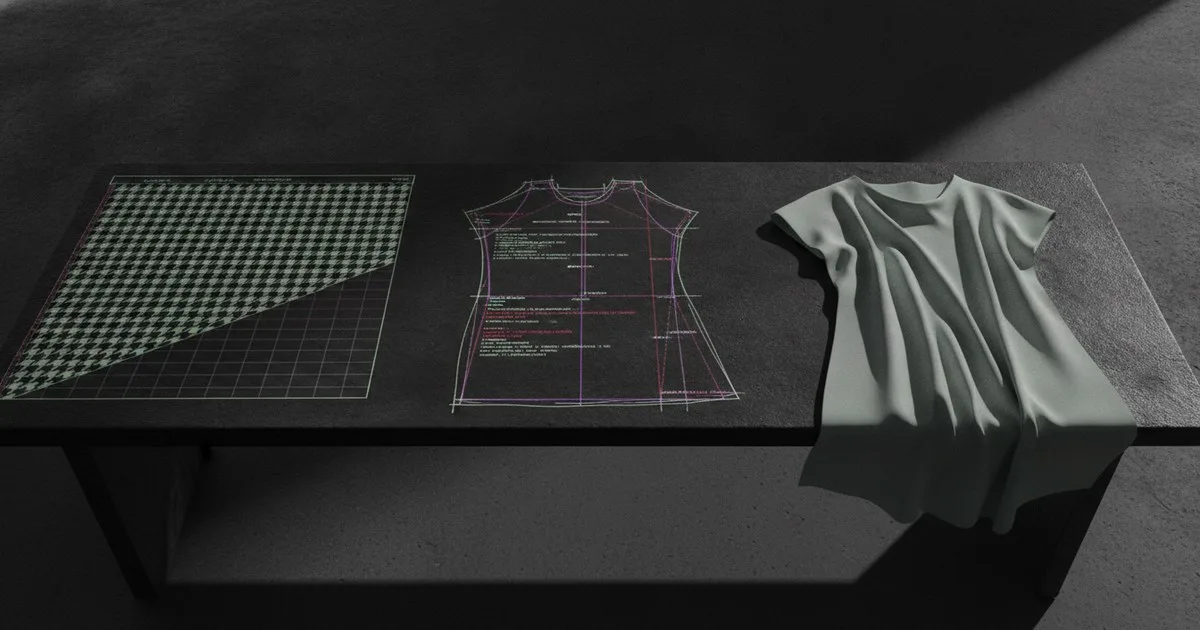
Four families of algorithm do almost all the generative work in fashion, and they are not interchangeable. Rule systems such as cellular automata generate surface structure; parametric models generate geometry that stays manufacturable; adversarial networks generate narrow imagery fast; diffusion models generate broad, heavily conditionable imagery. Choose by the artefact you need — a repeat, a pattern block, a texture, a render — not by which family is newest.
Key takeaways
- The choice follows the artefact: rule systems and parametric models emit geometry, while adversarial and diffusion models emit pixels.
- Cellular automata are the cheapest route to a controllable family of surface patterns, because the rule is the design brief.
- Parametric models are the only approach here whose output can be graded and cut without someone redrawing it by hand.
- Adversarial networks still win on latency and per-image cost inside a narrow domain; diffusion wins on breadth and conditioning.
- None of the four knows anything about fabric mechanics, so drape is something you add downstream, never something you generate.
What are the four generative design approaches used in fashion?
Every item below has the same shape: what the approach is, how it works, where it fits in a garment pipeline, and where it breaks down.
1. Cellular automata and rule-based generation
A cellular automaton is a grid of cells whose state updates from its neighbours according to a fixed rule. Run the rule and structure emerges that nobody drew, which is why the approach keeps reappearing in textile design, where the deliverable is a repeat rather than a picture. Design research has done exactly this with pied-de-poule, generating whole families of houndstooth structures and treating the familiar version as one member of a much larger set (cellular automata-based generative design of pied-de-poule patterns).
- How it works: define the lattice, the neighbourhood and the update rule, seed an initial state, then iterate. The rule plus the seed is the whole model, so output is deterministic, reproducible and regenerable at any resolution.
- Where it fits: print repeats, jacquard and knit structures, laser and perforation layouts — anything that has to tile seamlessly and be re-cut to a different scale without resampling.
- Where it breaks down: the method has no notion of a brief. You get a search space rather than a selection, curation stays human, and there is no route from a rule to a garment shape.
2. Parametric models
Parametric design encodes a garment as measurements, constraints and construction logic instead of fixed outlines. Change a chest measurement or a seam allowance and the geometry re-solves rather than needing to be redrawn. It is the only family here whose output is manufacturable geometry instead of an image.
- How it works: express blocks as parameters and relations — dart intake as a function of the bust-to-waist difference, sleeve cap length tied to armhole girth — then solve the constraint system and emit curves that can be graded and nested.
- Where it fits: block generation, made-to-measure, grading rules and garment variants; anywhere a pattern has to stay valid after someone changes an input.
- Where it breaks down: the constraint system is the actual work, and it encodes a patternmaker's craft. Ease distribution and fit intent resist parameterisation, so a system can solve cleanly and still emit a pattern nobody would sew. Interchange is the second trap: geometry that cannot round-trip through the flat-pattern formats a factory reads is geometry nobody downstream can use.
3. Adversarial image synthesis
An adversarially trained generator learns to produce images a discriminator cannot separate from real ones. In fashion this did the first genuinely useful work in colourway generation, texture synthesis and try-on compositing, and it stays competitive wherever the domain is narrow and latency matters more than variety.
- How it works: generator and discriminator train against each other, and conditioning on a sketch, a mask or a palette turns a sampler into a directed tool. Inference is one forward pass, which keeps per-image cost and response time low.
- Where it fits: fixed-domain work at volume — recolouring a catalogue into new palettes, synthesising texture tiles, warping a garment onto a body in an interactive surface.
- Where it breaks down: training instability and mode collapse. A model trained on dresses does not cover tailoring without a new training run, and text conditioning is crude next to what diffusion gives you. Evaluation is awkward as well: distributional image scores tell you the samples look like the training set, not whether a merchandiser would sign off on them, so human review stays in the loop.
4. Diffusion-based generation
A diffusion model learns to reverse a noising process, denoising step by step towards an image. It has become the default for design imagery because conditioning is cheap and composable: text, a sketch, an edge map, depth, pose, or a small adapter tuned on an internal image set. Most commercial AI design tooling for fashion now targets this kind of generation — Refabric is positioned for AI-assisted fashion design, Raspberry AI spans sketch-to-render, print and graphic generation, multi-view output and try-on, and broader creative suites go after the same work, including Flora AI with its fashion studio module and Adobe Firefly inside Creative Cloud.
- How it works: sample noise, denoise iteratively under a conditioning signal, decode to pixels. Control comes from cross-attention on text plus adapters that inject structure — edges, pose, depth — and from low-rank fine-tuning on a brand's own imagery. Pin the seed and the scheduler if you want an approved image to be reproducible later, because sampling is otherwise a fresh draw every run.
- Where it fits: concept boards, colourways, print artwork, sketch-to-render passes and on-model imagery. A March 2026 survey of generative AI use cases in fashion puts the strongest fit with retailers that need high volumes of varied designs quickly (AIMultiple).
- Where it breaks down: geometry. A render is a plausible picture, not a specification: seam lines drift, closures fail to align, and nothing in the output tells a factory how to cut it. Sampling cost is real too, since every image pays for many denoising steps.
How do you choose between them?
| Approach | What it emits | Where it fails |
|---|---|---|
| Cellular automata | Tileable surface structure from a rule | No brief, no garment shape |
| Parametric models | Gradeable, cuttable geometry | Encoding fit intent as constraints |
| Adversarial synthesis | Fast images in a narrow domain | Domain shift, unstable training |
| Diffusion | Broadly conditionable imagery | Geometric precision, sampling cost |
Read the table by output, not by novelty. If the deliverable ends at a screen, the pixel approaches are enough. If it ends at a cutting table, something parametric has to sit between the render and the marker, because no image model emits a seam allowance.
Two practical notes. First, none of the four models fabric mechanics, which is why generated imagery and simulated drape are separate problems — the argument we make at length in our piece on why fabric simulation still fails at scale in production. Second, generated output has to be read back into structured data before it is useful downstream, and that is a computer vision job rather than a generative one; our list of the computer vision tasks fashion engineers actually ship covers the tagging, parsing and retrieval side. Teams building on open geometry stacks should also look at our roundup of open-source pattern-drafting tools.
FAQ
Which generative approach produces a pattern you can actually cut?
Parametric modelling. It is the only family whose output is constrained geometry rather than pixels, so the result can be graded, nested and sent to a cutter. Diffusion and adversarial models produce appearance; converting that appearance into cuttable geometry is a separate step.
Are adversarial models obsolete for fashion imagery?
No. Inside a narrow domain they remain cheaper per image and faster at inference, which matters for interactive surfaces and bulk catalogue work. Diffusion wins where you need broad coverage, strong text and structural conditioning, or a single model across many product types.
Can a diffusion model design a garment rather than a picture of one?
It designs appearance. Construction, ease and seam placement come from a parametric or CAD step afterwards, so treat the render as a brief that still needs engineering rather than as a specification.
What data does each approach need?
Cellular automata need a rule and a seed, not a dataset. Parametric models need measurement standards and construction knowledge. Adversarial and diffusion models need images at scale, plus documented rights to train on them.
Where does fabric simulation fit in this taxonomy?
It does not: simulation is validation, not generation. It takes geometry and material parameters and predicts behaviour, which is why it pairs with the parametric approach and cannot rescue a pixel-only pipeline.
Further reading
- Fashion 4.0 designers as cyborgs: two approaches to algorithmic fashion design
- McKinsey on generative AI and the future of fashion