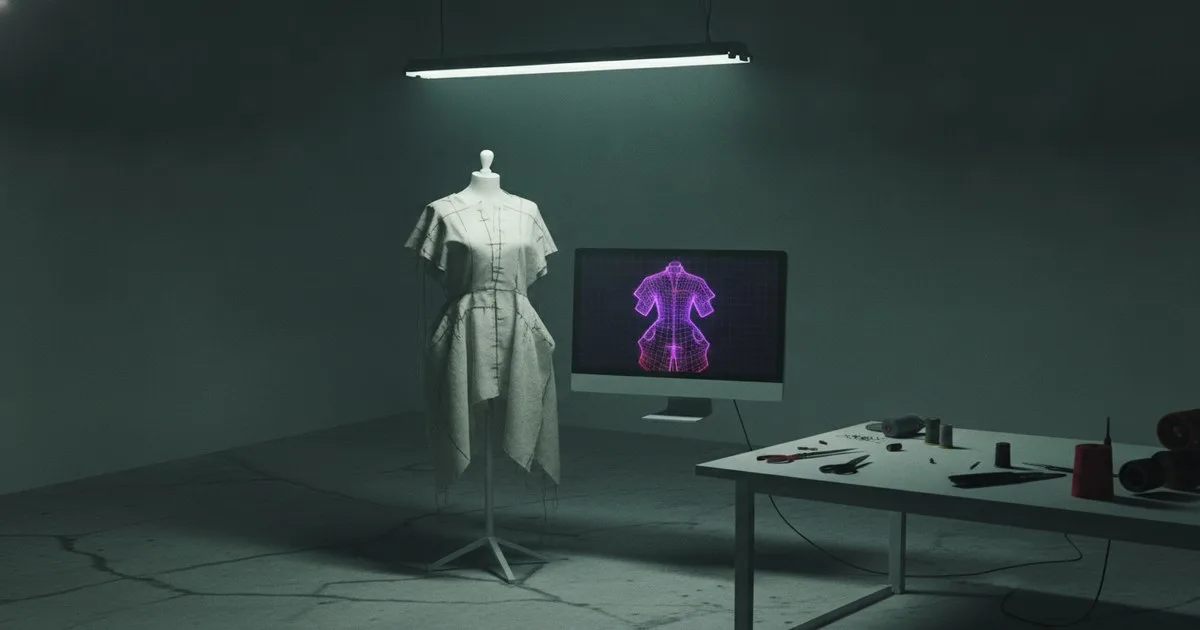
AI and 3D tooling have fixed a narrow set of problems in apparel production: the number of physical samples needed to agree on a shape, the time it takes to approve a colorway, and the cost of putting a garment on a body in an image. Each is repeatable and defensible in a budget review. The wider claims, that design is automated end to end or that fit is solved, remain pilots and internal arithmetic. This piece separates the two.
Key takeaways
- 3D review has removed samples circulated for approval on proven blocks, but not the last physical fit before a production order.
- Colorway and artwork iteration is the clearest win, because color is a parameter change while construction is a geometry change.
- On-model imagery moved before pattern making did, since rendering a garment on a body is a smaller problem than predicting how it behaves.
- Intent to adopt generative AI is documented far better than per-brand production savings, so ask which numbers were measured and which were modelled.
- Fabric behaviour, fit across real bodies and the provenance of generated content remain open problems.
What counts as "actually fixed"?
Set a hard definition or the discussion drifts into anecdote. A fix changes an operational metric, survives a full season, works when the person who ran the pilot is away, and shows up in a count someone else can audit: samples shipped, days to approval, images produced. By that standard the wins cluster into a few shapes:
- Removed steps: a physical artefact nobody makes any more.
- Compressed steps: the same decision reached in hours instead of weeks.
- Cheaper steps: the same output with less studio time, freight and manual rework.
Digital product creation is the umbrella term for the first two: pattern, fabric and trim data assembled into a garment people review before it exists. It is a workflow change, not a rendering trick, and confusing the two is where stalled rollouts begin.
Which physical samples has 3D actually removed?
The samples that have genuinely disappeared are the ones made so somebody could look at a shape and say yes: proto rounds, approval samples, licensor reviews. If the style sits on a block your pattern room has proven, in a fabric you have measured, a simulated garment answers the question the sample existed to answer.
What has not gone away:
- The first fit on a real body for any new block or new construction.
- Hand feel and finish approval on the actual substrate, plus wash and shrinkage testing.
- The production line first-off, which catches the sewing sequence rather than the shape.
The pattern that works is substitution, not elimination: fewer rounds of the same sample, with the surviving physical round scheduled later and spent on a harder question. Decorated apparel shows the mechanism plainly. Seddi builds true-to-pattern digital replicas of real blank garments, so artwork placement and client proofing happen against actual garment geometry before anything is printed.
Why is colorway iteration the clearest win?
Because recoloring does not change geometry. One simulated garment carries any number of colorways, prints and placements, and nothing is re-cut or re-sewn. Print scale, repeat and placement get checked against the real pattern pieces instead of a flat sketch, which is where placement errors used to survive until the sample landed.
The win holds only under conditions:
- Measured materials. A fabric that was eyeballed rather than measured moves the argument onto a screen without settling it. Digital textile platforms exist to produce that data, and Seddi also operates Textura.ai for generating 3D digital textiles.
- A calibrated color pipeline. Display profiling and spectral measurement of the physical substrate are unglamorous and non-optional. Skip them and digital approval adds a second opinion instead of replacing the first, leaving you with lab dips and renders.
What actually changed in product imagery?
Rendering a garment onto a body proved tractable earlier than simulating how that garment moves, which is why imagery budgets shifted before pattern-making budgets did. Colorway extensions, body-type variants and territory-specific imagery are where a render replaces a shoot outright.
Virtual try-on is the consumer-facing end of the same pipeline. DressX ships an enterprise AI suite built around photorealistic full-body try-on embedded in product pages, aimed at conversion, product discovery and retention rather than at the sample room. Read the mechanism honestly: try-on communicates proportion and styling intent, not drape, as our explainer on the physics gap in virtual try-on sets out. A render is not evidence that a garment hangs correctly.
| What changed | What it replaced | What still needs something physical |
|---|---|---|
| 3D shape review | Samples circulated for approval on a known block | First fit on a real body; line first-off |
| Digital colorway and print sets | A sewn sample per colorway | Lab dip or strike-off on the real substrate |
| Rendered on-model imagery | A studio shoot per colorway or market | Imagery where movement sells the garment |
| Digital material libraries | Couriered swatch cards | Hand feel and finish approval |
What does the published evidence actually say?
Intent is documented far better than outcomes. Business of Fashion's State of Fashion work on generative AI reported that 73 percent of fashion executives said generative AI would be a priority for their business, which is a statement about budget attention, not about samples avoided.
McKinsey's analysis of generative AI in fashion argues at a similar altitude: better-selling designs, lower marketing cost, more personal customer communication. That is a case for where value could come from, not an audited ledger of savings.
So when a vendor deck hands you a percentage, interrogate it. What was the baseline season? Who counted the samples, and does the count include the ones the factory made anyway? Most published sample-reduction numbers come from a single-brand pilot on the most cooperative product that brand had.
What is still not fixed?
Fabric behaviour. Simulation is only as good as the measured mechanical properties fed into it. For an unmeasured fabric, the output is an approximation displayed at the same visual fidelity as a solved one, which is a reporting problem as much as a physics one. Our explainer on where fabric simulation ends and approximation begins goes deeper into that boundary.
Fit across real bodies. Avatars are parametric and customers are not. Grading a garment that fits one avatar across a full size range still needs pattern judgement, and returns data keeps surprising teams that treated a virtual fit session as final.
Ownership of the asset. The archive that makes any of this work is your own pattern and material data. Whether that data leaves your tenant for a shared model is a strategy decision, not an IT detail, as our piece on proprietary data as the moat argues.
Provenance of generated content. Disclosure rules are arriving faster than the tooling to satisfy them. In August 2026 one of the large model vendors published details of how it will watermark the text its chatbot generates in order to comply with the EU AI Act's Transparency Code, as TechCrunch reported. Nothing equivalent is settled for rendered product imagery, so keep your own record of which assets were generated, from which geometry, by which model version.
What should you measure before committing budget?
- Samples per style per season, counted the same way before and after, including factory-initiated samples.
- Days from approved tech pack to approved colorway.
- Share of product-page images rendered rather than shot, by category.
- Rework rate: styles needing an extra physical round after a digital approval.
- Cost to digitise each fabric, and how many styles reuse it.
If a programme cannot move several of those within a couple of seasons, the constraint is process ownership rather than software.
FAQ
Does 3D sampling eliminate physical samples?
No. It removes approval samples for styles built on proven blocks in measured fabrics. Fit approval on a real body, hand feel sign-off and the production first-off stay physical. Expect substitution and rescheduling rather than elimination.
Which gains are easiest to prove first?
Colorway and print iteration, plus on-model imagery for colorway or market variants. Both change parameters rather than construction, so the before-and-after count is clean and hard to argue with.
Can AI generate production-ready patterns yet?
Partly. Tools can draft blocks and propose grading from measurements, but production readiness depends on seam allowances, notches, grain and factory conventions that live in your own archive. Treat generated patterns as drafts a pattern maker finishes.
Why does virtual try-on disappoint on some garments?
Because try-on shows proportion, not drape. Fluid wovens, bias cuts and knits depend on mechanical properties most try-on pipelines approximate. Structured garments in measured fabrics read correctly; anything that hangs or swings does not.
What is the biggest hidden cost?
The data layer: measuring fabrics, cleaning legacy patterns, retraining the people who approve product. It is front-loaded, rarely inside the software quote, and the usual reason a programme stalls after its first season.
Further reading
- McKinsey's March 2023 analysis of generative AI in fashion: where the value is argued to come from across design, marketing and personalisation.