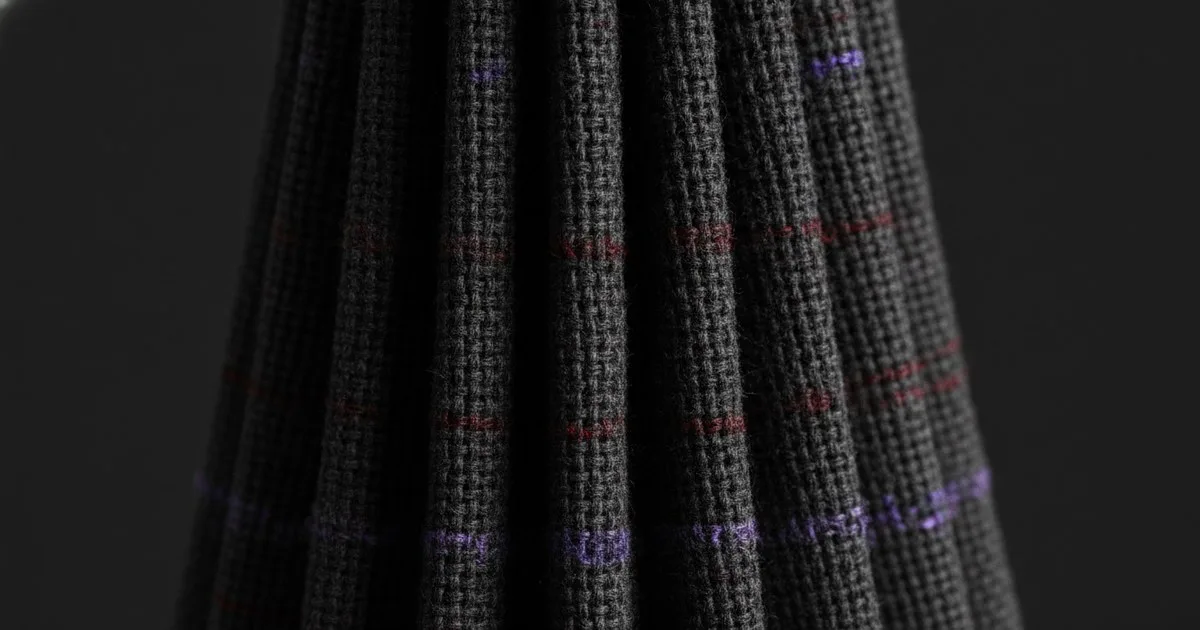
Fabric simulation in shipping apparel software solves a constrained geometry problem with a numerical integrator. The solver knows a mesh, a set of seams and a handful of tuned material parameters, and it advances that mesh until forces balance — it does not know what the cloth is made of. AI arrives at the edges of that loop: fitting parameters, smoothing output, replacing expensive solver steps with learned approximations. Each substitution trades a guarantee for speed, and none predicts real drape from material properties alone.
Key takeaways
- A cloth solver computes the equilibrium of a mesh under constraints; it derives nothing from fibre chemistry or weave structure.
- The physics stays honest as far as your measured parameters go; past that point the simulator is running a fit, not a prediction.
- Neural surrogates buy interactive frame rates by learning a pose-to-deformation mapping, and inherit the limits of their training data.
- Contact and friction, not bending, take most of the compute budget and cause most of the visible errors.
- No tool today turns a mill spec sheet into a drape you can approve a garment on.
What does a fabric simulator actually compute?
Three things: a discretised garment, an energy model, and a time integrator.
The garment arrives as flat panels — the same geometry a patternmaker cuts — triangulated into a mesh and stitched along seam lines. The energy model prices deformation: stretch along the warp and weft directions, in-plane shear, bending across edges. Anisotropy matters, because woven cloth resists stretch along its yarn directions far more than it resists shear, and a solver treating fabric as an isotropic elastic sheet reads as rubber.
The integrator advances the system. Explicit integration is cheap per step but needs tiny timesteps to stay stable with stiff cloth. Implicit integration takes large steps and stays stable, at the cost of solving a large sparse linear system every frame — that solve is where the wall-clock time goes. Position-based methods sidestep stiffness by projecting constraints straight onto vertex positions, iterating until inextensibility, seams and collisions are close enough to satisfied.
Collision handling is the other half of the bill. A gathered skirt generates enormous numbers of self-contact pairs, each needing a broad-phase test, a narrow-phase test and a response that does not shove a vertex through the surface it just touched. Friction, meanwhile, is a coefficient rather than a measured response — and friction decides whether a sleeve stays on a shoulder.
Where does the physics end?
At the parameters. A continuum solver is faithful applied mechanics for the model it implements; what it cannot do is tell you which numbers to feed it.
Those numbers come from bench tests that load a swatch in tension, shear and bending — a point sample of one piece of cloth, in lab conditions, in one state. What ships differs: the roll was finished differently, the panel is cut off-grain, an interlining is fused into the front, the seam allowance is a stiff sandwich of layers. Hysteresis, cloth failing to return along the path it deformed on, is usually discarded; a permanent crease is faked with geometry.
So a well-tuned simulation is a sound solver driven by parameters fitted until a known reference looked right. Change the garment class and the fit degrades. That is the boundary between physics and approximation, and it sits earlier in the pipeline than most tool demos imply.
How do neural surrogates fit in?
A surrogate learns the output of a solver instead of computing it. The usual shape is a network conditioned on body shape and pose, predicting vertex offsets from a skinned base mesh, trained on simulated frames of one garment. Inference is a forward pass, so you get deformation at interactive rates on hardware that could never run the solver live.
The failure modes are structural, not incidental:
- Distribution limits. The model reproduces what it saw. Poses, bodies or fabric settings outside the training set give plausible output with no relationship to mechanics.
- No hard constraints. A solver enforces non-penetration and inextensibility; a regression model is only penalised for violating them in training. Interpenetration at tight contact is the tell.
- Temporal behaviour. Frame-wise prediction jitters; adding history drifts. Neither reproduces the energy exchange that makes cloth settle.
- Data cost. Each garment needs its own dataset — generated by the solver you were trying to avoid.
Physics-informed losses and hybrids narrow the gap: a learned coarse deformation, then a short solver pass to fix contact. A hybrid is only as fast as the part you kept.
Which method fits which job?
| Method | What it computes | Where it breaks |
|---|---|---|
| Implicit continuum solver | Equilibrium of an anisotropic sheet under stretch, shear, bending, contact | Cost per frame; needs parameters it cannot infer |
| Position-based dynamics | Constraint projection onto vertex positions, iteration-limited | Effective stiffness moves with iteration count and timestep |
| Yarn-level simulation | Contact between individual yarns in a knit or weave | Compute cost restricts it to swatches, not garments |
| Learned surrogate | A mapping from pose and shape to vertex offsets | Only inside its training distribution; no constraint guarantees |
| Image-space generation | Pixels that look like cloth | No geometry, so nothing downstream can measure, grade or cut |
That last row is the substitution most often mistaken for simulation: a generated image of a garment is a rendering decision, not a mechanical one, which is the point of our piece on why virtual try-on cannot show drape.
Who is pushing this forward?
Vendor and research work sit at different points of the same problem.
Browzwear builds a 3D digital product creation platform — VStitcher, Lotta and SmartDesign — where physics-based simulation is used to design garments, validate fit with AI, run approvals and generate technical and e-commerce assets. Its direction is a connected workflow from first sketch to factory floor, aimed at cutting physical sampling.
Seddi comes at it from materials and visual proofing. Its Decorator is a 3D visual workspace for branded and decorated apparel, building true-to-pattern digital replicas of real blank garments for artwork placement, client proofing and production instructions. The company also runs Textura.ai, a cloud platform for generating 3D digital textiles.
On the research side, NVIDIA Research publishes across rendering, robotics and generative AI and releases open-source code libraries alongside the papers, which is how most simulation technique reaches practitioners at all. Meta AI Research, operating as Meta Superintelligence Labs, is pushing into autonomous agents and physical AI — work that hits your wall too, since a machine handling a deformable object must predict its behaviour first.
Why can't a model predict drape from material properties alone?
Because the chain from fibre to finished garment loses information at every link. Yarn twist and weave structure set bending and shear response, but so do finishing chemistry, coatings, calendering and washing, none of which arrive on a spec sheet in a form a solver can consume. Then construction intervenes: grain direction, seam type, stitch density, interlinings and pressing each stiffen or release parts of a panel the mesh treats as uniform.
Mapping material descriptors to drape would need paired data across that whole product of variables, measured on finished garments rather than swatches. No public dataset of that shape exists, and the organisations that could assemble one keep it — which is the argument we made about proprietary data being the real moat in fashion AI.
What breaks first in a production pipeline?
- Parameter drift. Material settings authored in the simulation tool rarely survive the trip to a renderer, so the approved look and the published look diverge.
- Version non-determinism. A solver update, a different iteration count or different hardware changes the result of the same file, and an approval you cannot reproduce is not an approval.
- Silent surrogate failure. A learned model does not error out on unfamiliar input; it returns something smooth and wrong.
Treat the simulator as an instrument: record its settings, keep a physical reference per material class, and re-measure when the mill, the finish or the solver version changes.
FAQ
Is AI replacing physics-based cloth simulation?
No. Learned models accelerate or approximate parts of the loop — deformation, contact fix-up, parameter fitting — while the solver stays the reference that generates their training data and validates their output.
Can a neural network run cloth simulation in real time?
Yes, for the garment and range of motion it was trained on. Inference is a single forward pass, so interactive rates are routine. Outside the training distribution, output stays smooth while becoming mechanically meaningless.
What is the difference between fabric simulation and virtual try-on?
Simulation computes geometry from forces and constraints. Most try-on tools generate pixels conditioned on an image, with no mesh underneath, so they cannot report drape, fit pressure or how a panel behaves.
What do I need before trusting a simulation for fit decisions?
Measured parameters for the actual material, seams and interlinings represented rather than ignored, a pinned solver version with recorded settings, and a physical reference garment you re-validate against when any of those change.