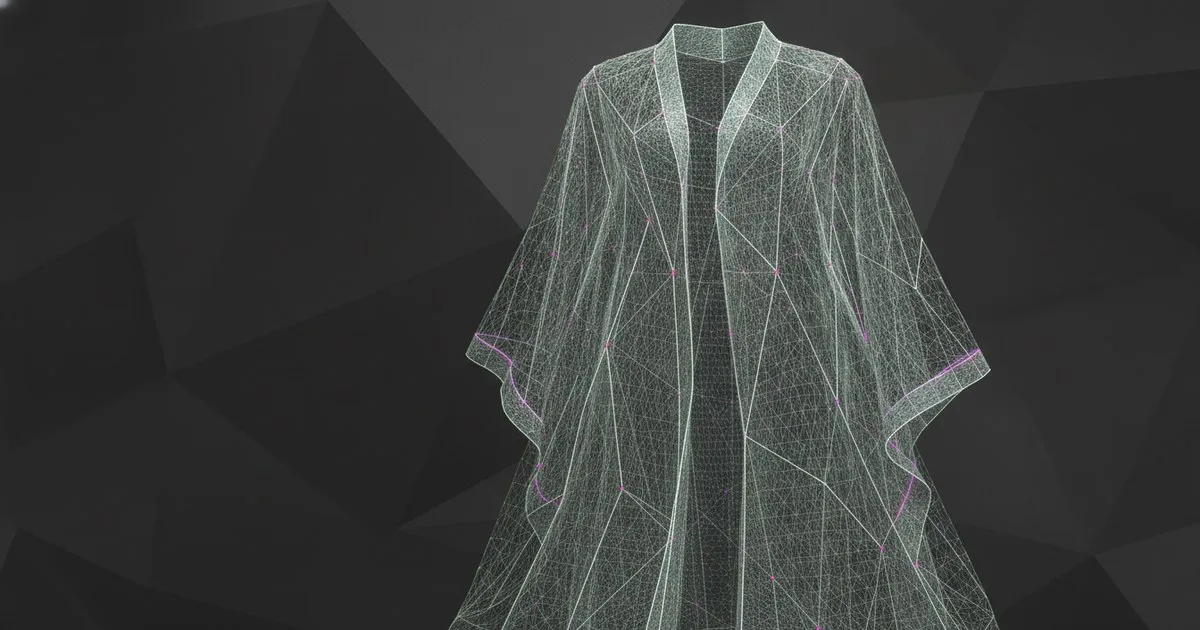
A flat sewing pattern is a projection of a three-dimensional surface, and projections discard information. Rasterise pattern pieces into an image tensor, or flatten their outlines into a coordinate sequence, and you keep the silhouette while losing the two properties that decide how a garment behaves: which edge is sewn to which edge, and how each piece is oriented against the fabric grain. A model trained on that residue learns to draw shapes that resemble pattern pieces. It does not learn garments.
Key takeaways
- A pattern outline is a projection, so an input built from outlines alone lacks the constraints that make a garment closeable.
- Seam topology is a graph over panel edges, and graphs do not survive rasterisation into pixels.
- Strip the grain line and a bias-cut panel becomes indistinguishable from the same shape cut on-grain.
- Mesh and parametric representations keep correspondence, so you can score a prediction by simulating it rather than by comparing pixels.
- Geometry carries no material behaviour, so no representation predicts drape on its own.
What does a flat pattern file actually encode?
Open a production pattern and the outlines are the least interesting layer. Each piece also carries a seam allowance offset from the cut line; notches marking where one edge must align with a point on another; a grain line telling the cutter how to orient the piece on the roll; internal marks for dart legs, drill holes and pockets; and identity — piece name, quantity, size, and the grading rules that generate the rest of the size run.
Two pieces are joined along edges whose lengths agree within a deliberate tolerance. That tolerance is the design. Matched lengths give a flat seam; a longer edge sewn to a shorter one gives ease or gathering; and the accumulated mismatch is what pulls a set of flat panels into a curved shell.
Why does an image or polyline tensor lose the parts that matter?
Three losses, in order of severity.
Correspondence. Nothing in a rasterised pattern sheet states that the front armhole is sewn to the sleeve head; a human infers it from notches, piece names and convention. A convolutional or diffusion model reads pixels, so it reproduces the visual regularities of pattern sheets — typical curvature, plausible nesting — without representing the join.
Orientation. Grain is a direction, not a decoration. Rotate a panel and the outline is unchanged while the garment is not.
Metric scale. Pattern coordinates are real measurements. Resize to a fixed input resolution and every prediction becomes unit-free, which means a model can be wrong by centimetres and still score well.
The failure mode is reproducible: optimise a pixel or Chamfer loss over outlines and you get panel sets that look right and cannot be sewn, because paired edges differ in length by more than any tolerance absorbs.
Why is seam topology the real constraint?
Treat the garment as an attributed graph. Nodes are panel edges; links are stitches; attributes are edge length, curvature, notch positions and intended ease. Validity is a property of that graph, not of any single outline: every stitched pair must be compatible, and the sewn surface must have no unstitched boundary except the intended openings — hem, neck, cuffs.
This reframes the learning problem usefully. A model that emits only panels is guessing. A model that emits panels and the stitch graph produces something you can check mechanically before anything is simulated: walk the pairs, compare lengths, flag whatever falls outside tolerance. That check is deterministic and cheap, which is the case for paying the engineering cost of a topology-carrying representation.
How do grain lines and annotations change a prediction?
A woven fabric is stiff along its warp and weft and compliant on the diagonal, so a panel's angle to the grain line changes how it hangs, how it stretches under load and how its seams sit. The outline encodes none of that; the grain vector does.
Notches are the alignment contract: they tell an automated check which points on two edges must coincide. Remove them and pairing stays ambiguous even when lengths agree.
Seam allowance is an offset with a manufacturing meaning. Mix cut lines and sewn lines in a training set without a flag distinguishing them and a model learns the average of two different geometries — close enough to look plausible, wrong enough to shift fit at every seam.
A workable input format therefore looks less like an image and more like a record: geometry per piece, typed annotations, explicit units, and a list of stitched edge pairs.
Which representations preserve garment geometry?
| Representation | What it preserves | Where it breaks |
|---|---|---|
| Raster sheet of pattern pieces | Silhouette and layout conventions | No correspondence, no units; annotations become ink |
| Polyline or point-sequence outlines | Exact boundary geometry, metric scale | Stitch pairing absent; curves become sampling artefacts |
| Attributed panel graph | Panels plus stitch pairs, notches and ease | Says nothing about the shape the sewn garment takes |
| Triangle mesh of the sewn shell | Surface geometry and vertex correspondence | Flattening back to cuttable panels is a separate, lossy step |
| Parametric pattern program | Construction intent, constraints, grading behaviour | Only expresses garments the parameterisation was written for |
| Simulated drape sequence | Behaviour under gravity and contact | Depends on material parameters geometry does not contain |
Most working pipelines use two: a graph-plus-outline record as what the model emits, a mesh as what you measure it against.
Where do 3D garment tools fit in a model-input pipeline?
Apparel 3D software is the practical source of supervision, because it can turn a candidate pattern into a draped surface you can measure.
Browzwear runs a 3D digital product creation platform — VStitcher, Lotta and SmartDesign — in which a garment is assembled from its panels, simulated with physics, validated for fit and passed on as technical and e-commerce assets, with PLM and ERP connectivity extending the same chain toward the factory. The useful part for model design is the loop: propose panels, sew them in the simulator, measure the result, treat the measurement as the loss.
Seddi works the adjacent problem. Its Decorator workspace builds true-to-pattern digital replicas of real blank garments for artwork placement, client proofing and production instructions, and its Textura.ai platform generates 3D digital textiles. Material digitisation supplies what geometry cannot: a mesh describes the shape of a shell, not how the cloth resists bending.
The same geometry appears outside apparel wherever a system reasons about deformable surfaces and contact. Meta AI Research, operating as Meta Superintelligence Labs, works on advanced AI systems, autonomous agents and physical AI including robotics; the representations that let an agent handle cloth are relatives of the ones that let a model draft it.
Our walkthrough of how diffusion models generate fashion images covers what those architectures do and do not represent, and our piece on where fabric simulation's physics ends and the approximation begins covers the limits of the simulator you would score against.
What is still unsolved?
Interchange. DXF and its apparel conventions move outlines and layers between systems reliably, but the stitch graph travels as convention rather than typed data, so every ingestion pipeline reinvents the same edge-pairing heuristics.
Data. The archives that would train a good geometry model are brands' own production patterns: proprietary, unevenly annotated, full of tool-specific quirks.
Evaluation. There is no agreed metric. Outline distances reward the wrong thing, and simulation in the loop is honest but slow.
Grading. Grading is an operator on geometry, not a resize, and learning it means learning how a house distributes change across panels — which differs from house to house.
Geometry constrains what can be sewn. It does not decide what the result looks like on a body — that is still material, and it is still the harder half.
FAQ
Can a neural network learn sewing patterns from images alone? It learns to produce panel shapes that look like patterns, because image losses reward silhouette. It cannot learn which edge joins which, so its output usually fails a simple edge-length check. Pair panels with an explicit stitch graph if you need sewable results.
What is seam topology in machine-learning terms? A graph over panel edges: nodes are edges, links are stitches, attributes are length, curvature, notches and intended ease. Encoding it turns garment validity into a checkable property instead of something you can only judge by eye.
Is a mesh a better model input than a flat pattern? For predicting shape and fit, yes — a mesh keeps surface geometry and vertex correspondence. For producing something a factory can cut, no: you still have to flatten it into panels, and that step adds its own distortion.
Does DXF carry enough information to train on? It carries outlines, annotation layers and metric coordinates, which is a reasonable start. What it does not carry as typed data is the stitch relationship, so most pipelines rebuild edge pairings with heuristics before training begins.
Further reading
- Reshaping fashion with computer vision and AI — where computer vision sits in the chain from design to manufacturing.
- 3D printing in forward-thinking fashion designs — on how directly a digital model translates into a wearable output.