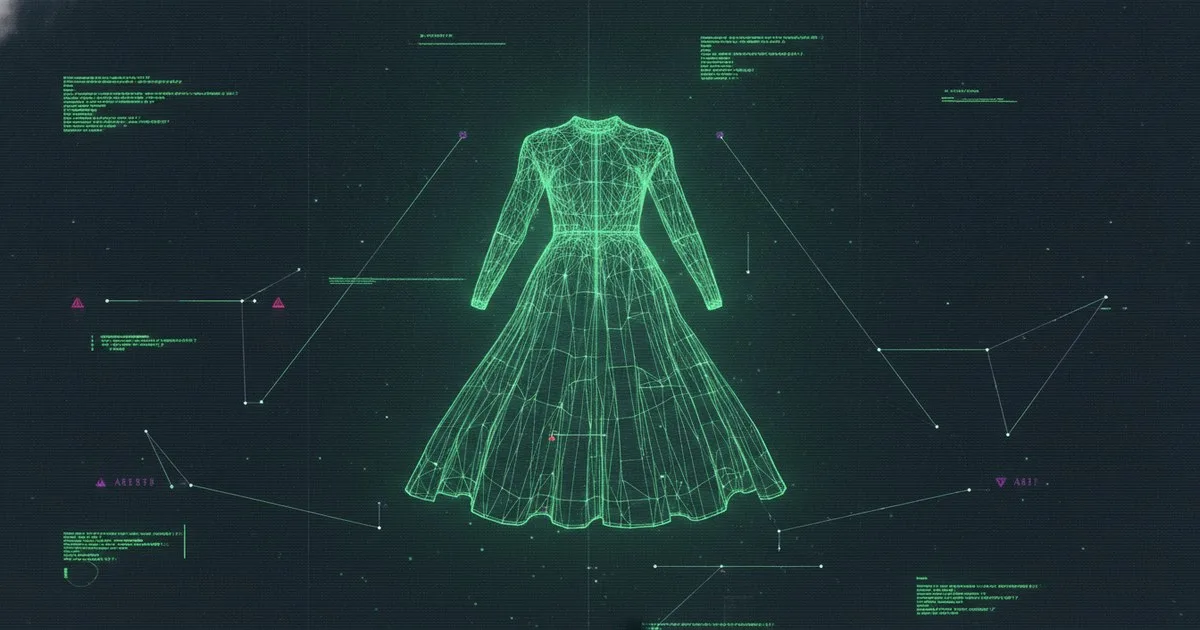
To build or integrate a fashion AI platform, you must first decide how the system "sees" a garment. A JPEG is insufficient for production; your backend requires a structured representation that accounts for geometry, topology, and material physics. Choosing the wrong data model leads to simulation artifacts, unmanufacturable patterns, and broken supply chain integrations.
Key takeaways
- Panel graphs are the foundation for translating generative designs into production-ready 2D patterns.
- UV-unwrapped meshes provide the necessary bridge between 2D texture maps and 3D spatial geometry.
- Point clouds are high-fidelity for raw sensor data but lack the topological logic required for garment assembly.
- Attribute trees ensure that geometric data remains synchronized with physical Bill of Materials (BOM) data.
- Parametric encodings allow for rapid style exploration by representing garments as vectors in a latent space.
How do AI systems represent the relationship between 2D patterns and 3D drapes?
Modern systems use a multi-layered approach to bridge the gap between flat pattern pieces and their three-dimensional form. This involves mapping 2D coordinates to 3D vertices, often through a system of constraints that define how edges are sewn together. For engineers, the challenge is maintaining this mapping during real-time deformation or generative resizing.
1. UV-Unwrapped Meshes
This is the standard representation for 3D visualization, where a garment is treated as a collection of vertices, edges, and faces. The UV-unwrapping process maps these 3D coordinates to a 2D plane, allowing for the application of high-resolution textures and displacement maps.
- → Pros: High visual fidelity and compatibility with standard GPU rendering pipelines.
- → Cons: Often lacks the underlying pattern logic needed for manufacturing.
In your workflow, you might use a platform like Vntana to manage these 3D assets across various web and AR environments. These meshes are optimized for viewing but require a secondary layer of data if you intend to extract a physical pattern from the digital twin.
Best for: Real-time rendering, AR try-on, and consumer-facing visualizations. Limits: Non-manifold geometry can break physical simulation engines.
2. Panel Graphs
A panel graph represents a garment as a topological network where nodes are 2D pattern pieces and edges are the seams connecting them. This structure is essential for any AI that needs to understand the assembly logic of a piece of clothing.
- → Pros: Preserves the "sewing instructions" and allows for procedural garment assembly.
- → Cons: Computationally expensive to resolve when panels have complex, non-linear edges.
When you build a generative model on top of panel graphs, the AI learns the valid ways to connect components—sleeves to armholes, collars to necklines. This ensures that the output is not just a 3D shape, but a set of instructions that a factory can actually execute.
Best for: Generative pattern making and automated tech pack creation. Limits: Difficult to represent complex internal reinforcements or bonded seams.
3. Point Clouds
Point clouds are unordered sets of 3D coordinates (x, y, z) typically captured from LiDAR or depth-sensing cameras. In the context of computer vision, they are used to represent the raw surface of a garment or a human body without the assumptions of a mesh.
- → Pros: Captures extreme detail and organic shapes without needing a predefined topology.
- → Cons: Lacks connectivity data, making it difficult to simulate drape or movement.
According to research in Applications of Computer Vision in Fashion and Textiles, point clouds are instrumental in 3D human body modeling and textile defect detection. They serve as the ground truth for quality control systems that compare a finished physical product against its digital original.
Best for: 3D body scanning, quality control, and raw data ingestion. Limits: Extremely high memory overhead for dense datasets.
4. Parametric Encodings
Parametric encodings represent a garment as a point in a high-dimensional latent space. Instead of storing every vertex, the system stores a set of variables (parameters) that define the garment's style, size, and fit.
- → Pros: Enables smooth interpolation between styles and extremely fast design iteration.
- → Cons: The mapping from a latent vector back to a production-ready pattern is often lossy.
This data structure is what powers "style sliders" in design tools. By adjusting a single parameter, you can transform a crew neck into a V-neck. The AI handles the complex geometric shifts in the background, keeping the garment's overall structure consistent.
Best for: Design exploration and recommendation engines. Limits: Often requires a large, labeled dataset to train the encoding effectively.
5. BOM-linked Attribute Trees
A garment is more than its shape; it is a collection of materials, trims, and metadata. Attribute trees are hierarchical structures that link geometric entities to their physical properties and sourcing data.
- → Pros: Ensures that design changes automatically update the Bill of Materials (BOM).
- → Cons: Requires strict schema enforcement to prevent data corruption between systems.
Platform solutions like Backbone PLM, which is now operated under Bamboo Rose, use these structures to manage the product lifecycle. As designers like Sander Lak prepare for events like New York Fashion Week on 2026-08-17, the backend systems managing their collections rely on these trees to ensure that a 3D visual update also updates the cost and material requirements in the tech pack.
Best for: Supply chain management and production-scale product development. Limits: Can become overly complex for simple, fast-fashion workflows.
6. Volumetric SDFs (Signed Distance Fields)
Signed Distance Fields represent a garment as a mathematical function that returns the distance to the nearest surface at any given point in space. This is a volumetric approach rather than a surface-based one.
- → Pros: Simplifies collision detection between the garment and the body.
- → Cons: Not human-readable and difficult to convert back into 2D pattern pieces.
Research into 3D printing for fashion, such as work conducted at UCLA, illustrates the need for precise volumetric data when translating digital models into physical objects. SDFs allow simulation engines to handle complex layering—like a jacket over a hoodie—without the "clipping" artifacts common in mesh-based systems.
Best for: High-fidelity physics simulation and 3D printing. Limits: High computational cost for real-time interactive applications.
Comparison of Garment Data Representations
| Representation Type | Best For | Limits |
|---|---|---|
| UV-Unwrapped Mesh | Visual fidelity / AR | Poor for pattern extraction |
| Panel Graph | Manufacturing logic | Complex seam resolution |
| Point Cloud | Raw scan data | No topological connectivity |
| Parametric Encoding | Rapid style iteration | Lossy reconstruction |
| Attribute Tree | BOM and PLM sync | High schema maintenance |
| Volumetric SDF | Collision / Simulation | Non-human-readable |
FAQ
Can I convert a 3D mesh back into a 2D pattern?
Yes, but it is a lossy process. You must use "unflattening" algorithms that account for fabric shear and strain. Without an underlying panel graph, the resulting 2D pieces may be physically impossible to sew together or may not represent the original grain lines of the fabric.
Why do PLM systems use different data structures than 3D engines?
PLM systems focus on the relational data of the supply chain (vendors, costs, materials), while 3D engines focus on spatial geometry and physics. Integrating the two requires a middleware layer that maps attribute trees to mesh vertices or panel nodes to ensure data consistency.
What is the most efficient format for training a garment GAN?
Parametric encodings or low-resolution panel graphs are typically most efficient. They reduce the dimensionality of the problem, allowing the GAN to focus on stylistic features rather than the raw physics of every individual vertex in a high-density mesh.
How does fabric physics fit into these data structures?
Fabric properties (weight, bend, stretch) are usually stored as attributes within the mesh vertices or as metadata in the attribute tree. During simulation, the engine reads these values to calculate how the data structure should deform under gravity or motion.
Further reading
- Applications of Computer Vision in Fashion and Textiles
- UCLA architecture professor uses 3D printing in fashion
- Sander Lak Joins CFDA Calendar Ahead of NYFW